00:00:00

00:00:00

spotlight

A new world in the shell of the old - An evening with ECCHR and guests at Spore Initiative, Berlin

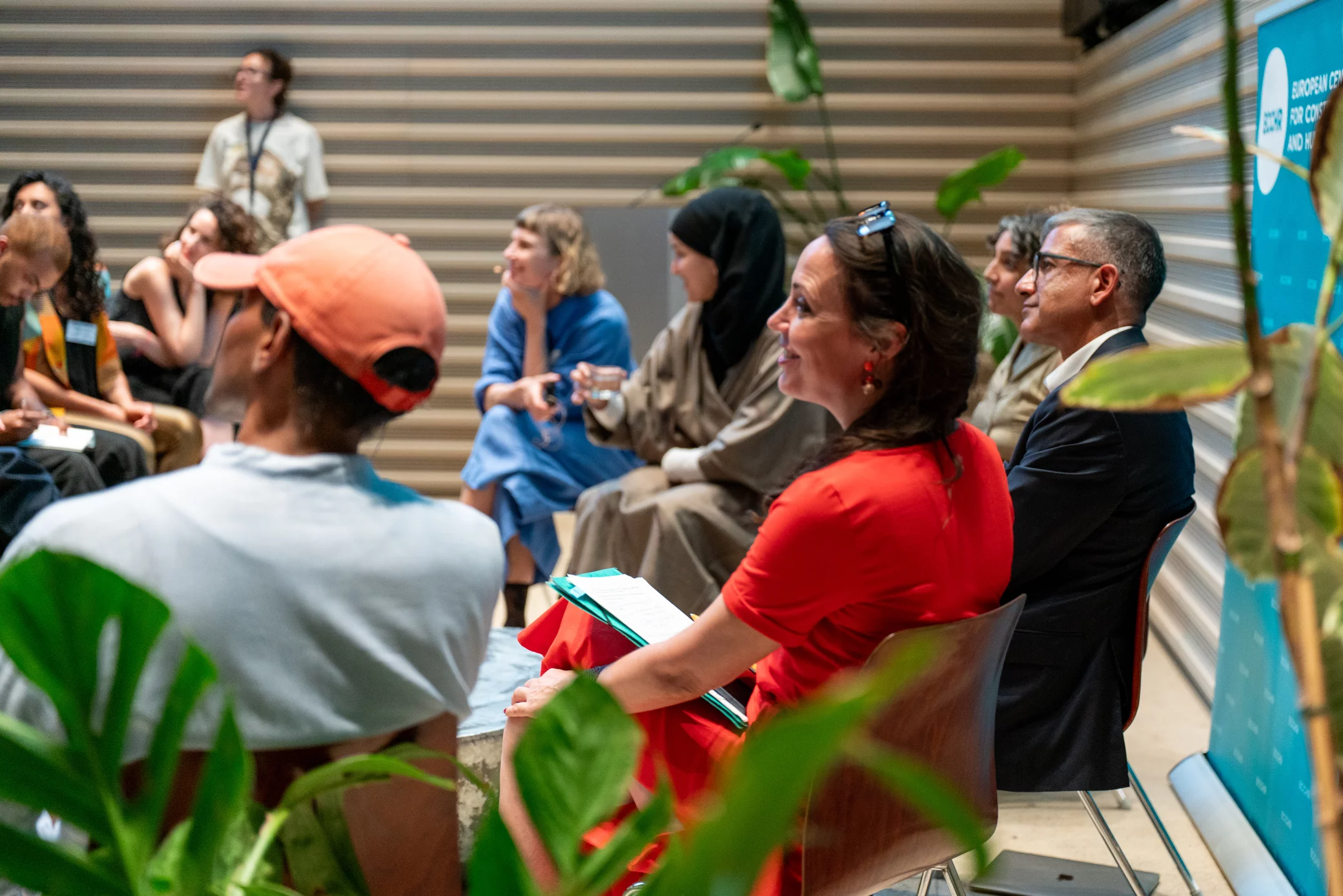
What does it mean to imagine different futures in a world shaped by systems of inequality, exploitation, and growing authoritarianism? And how can we begin building such futures within the very conditions that shape the present? These questions quided ECCHR’s public event A New World in the Shell of the Old – Radical Imagination and Visions of a Just Future, hosted at Spore Initiative in Berlin. Bringing together approximately 200 participants from around the world, the evening created a space for human rights defenders, legal practitioners, researchers, and activists to explore how imagination can become a political practice — and how visions of justice can materialize from dreams into collective action.

The event takes its title from the concept of prefiguration: the belief that the ways we organize, collaborate, and struggle today can prelude to the societies we want to create tomorrow. Rather than passively awaiting a future transformation, prefigurative thinkers ask how the seeds of a more just world can already be planted in the present.

Listen here to Clinical Professor of Law, UC Irvine,
Sameer Ashar’s “Using the Method of Prefiguration for Rethinking Justice”

00:00:00

Opening the event, Claire Tixeire, Co-Director of the Institute for Legal Intervention at ECCHR, framed the discussion around a central challenge: confronting systems that evade responsibility while imagining alternatives. Referring to the Lafarge case as a landmark in efforts to hold corporate actors accountable for international crimes, she highlighted the transformative potential of strategic litigation. Yet, she argued, resistance alone is not enough. Equally important is the work of prefiguring the futures that movements seek to build.

For ECCHR's Hanaa Hakiki, law is not merely a theoretical framework but a contested terrain of struggle:

“We practice the law instead of just thinking about it,” she explained, emphasizing that hope requires action and imagination: “Hope is a duty in these times.” - Hanaa Hakiki

Building on these opening reflections, a panel discussion brought together Sameer Ashar (UC Irvine School of Law), Duru Yavan (antenna, formerly Hafıza Merkezi Berlin), Ouassima Laabich (Superrr Lab) and Miriam Saage-Maaß (ECCHR). It was followed by a closing intervention by Vince Warren, from the Center for Constitutional Rights in New York.

The roundtable turned to a fundamental question: what distinguishes emancipatory futures from those envisioned by the institutions and actors already in power? Dominant systems tend to frame the future as something external—an object to be predicted, controlled, and managed in order to preserve existing hierarchies. Transformative movements, by contrast, approach the future as a collective practice: something to be imagined and built together. As Duru argued, worldbuilding is not the exclusive domaine of experts and policymakers. It is a shared political process of redefining what the future can be and who gets to shape it.

This perspective also requires asking whose futures are recognized as imaginable in the first place. Ouassima challenged a long history in which Muslim communities have been cast primarily as respondents to narratives authored by others. Reclaiming the power to envision desirable futures means reclaiming the legitimacy of longing itself. As she reminded the audience, utopia is not a blueprint for a perfect world but a horizon—an orientation toward possibilities that have yet to be realized.

"When we talk about the dismanteling and demontation of what is and what we have right now we need to at the same time imagine alternatives. It is the practicing of both: the critiquing of what is problematic and then imagining otherwise and practicing it."
- Ouassima Laabich

The role of law emerged as one of the central threads running through the discussion. Although legal systems have often been used to reinforce existing power structures, the speakers insisted that law can also serve as a site of contestation—a place where new political possibilities are opened. As Miriam Saage-Maaß argued, legal work is not only about winning cases but about asking “what if?” and expanding the horizon of what justice might look like.

“The law is often a tool of the powerful, but it is also primarily a subject of social contestation. Law is not static. In the legal processes, it really is a struggle for hegemony. Law does give us the room – through procedure and also through legal imagining - to fight for a space for progress and to ask: how should this law be interpreted, and how should the claim be judged if this were a different world?” - Miriam Saage-Maaß

That vision, however, demands more than courtroom victories. It requires institutions to critically examine their own structures, rethink how they collaborate, and cultivate spaces for experimentation. The panelists emphasized the importance of building stronger alliances with social movements while remaining willing to confront institutional blind spots and contradictions. As Sameer Ashar put it, defending the rule of law is not enough if it leaves untouched the people and struggles that have long been rendered invisible.

„Law is one of the few languages power is forced to listen to” - Vince Warren

Vince Warren brought these themes together in the event's closing intervention. "Law is one of the few languages power is forced to listen to," he remarked, while emphasizing that legal strategies alone cannot bring about lasting change. They must be accompanied by compelling stories that reshape public imagination and by movements capable of sustaining collective action over time. For institutions committed to transformative justice, this means remaining accountable to the communities they serve and investing not only in legal expertise, but also in courage, solidarity, and the long-term work of building a different future.

In his closing remarks, Vince Warren underscored the importance of storytelling in confronting authoritarianism. While legal strategies remain essential, he argued, they are only one part of the work. Movements also need narratives that challenge dominant assumptions, inspire collective action, and expand the political imagination. Alongside activists and legal advocates, institutions have a responsibility to remain accountable to the communities they serve and to commit the resources, courage, and endurance that meaningful change requires.

00:00:00

The evening at Spore Initiative demonstrated that these questions are not only matters of theory but of practice. Bringing together legal practitioners, organizers, researchers, and artists, the event created a space where different experiences and ways of knowing could meet in conversation. Rather than offering a single vision of the future, it opened a shared process of imagining and beginning to enact the kinds of relationships, institutions, and forms of solidarity needed to bring more just futures into being.

Co-Director of the ECCHR Institute for Legal Intervention

Claire Tixeire

Directress of the Border Justice team

Hanaa Hakiki

Legal Director ECCHR

Miriam Saage-Maaß

Executive director of the Center for Constitutional Rights

Vince Warren

Speaker

Ouassima Laabich

Speaker

Duru Yavan

Speaker

Sameer Ashar

LOA is part of ECCHR. We are a human rights organization that relies solely on independent funding and donations from its community. 

Together we use the law to fight for a just world. Free from exploitation, fortressed borders and torture. Support our work with a donation!

LOA is part of ECCHR. We are a human rights organization that relies solely on independent funding and donations from its community. Support our work with a donation!

Donate now!

Thank you for supporting our work for a world free from exploitation, fortressed borders, and torture. Receive regular information and updates in our ECCHR newsletter—subscribe now!