00:00:00

00:00:00

spotlight

Wolfgang Kaleck in conversation with the artist Ahmed Isamaldin

The rhizome grows as a decentralized network

Ahmed Isamaldin (A.I.) is a media artist, graphic designer, and researcher from Khartoum who lives and works in Berlin. His work spans visual communication, artistic research, cartography, and 3D imaging, and explores issues surrounding the violent system of resource extraction.

His artistic research on Sudan provides the framework for the ECCHR’s 2025 Annual Report: Satellite images of gold mines, 3D models—how resource exploitation, the war economy, and spaces of resistance become visible when you look closely.

In conversation with ECCHR's Secretary General Wolfgang Kaleck (W.K.), he discusses his artistic practice and the history of protest movements and armed conflict in Sudan.

WHAT REMAINS OF A TRANSPORTATION SYSTEM REVEALS HOW WELFARE INFRASTRUCTURES ARE SUPPRESSED BY THE INTERTWINED FORCES OF SURVEILLANCE, EXTRACTIVISM, AND WARFARE.

● W.K.

How would you describe the development of your political and artistic career?

● A.I.

In Sudan, I was active in the democratic student movement. I left in 2011, mostly due to repression, and moved to Egypt, in the wake of the Arab Spring—a moment of collective liberation. Transnational solidarity required Arabic-speaking people to be in Cairo, in Tahrir Square. That hope turned into defeat, when the regime militarized and then proceeded to oppress human rights organizations and cultural spaces in 2015. I then moved to Berlin and studied at Kunst hochschule Weissen see. While I thought the movement in Sudan was defeated, it reorganized itself from the bottom up and reappeared in 2018. I began to see a strong, radical structure. In order to provide support from Berlin, we created a diaspora collective called “Sudan Uprising Germany” and organized exhibitions and events to reflect on what was happening in Sudan.

● W.K.

How have these political experiences shaped the forms and methods of your artistic practice?

● A.I.

For me, artwork should not be concerned with aesthetics alone, but with making sense of reality and confronting dominant norms. I aim to work from a universal perspective, but Sudan provides the core conceptual ground for my practice. When the war in Sudan started in 2023, I set out to examine the material economy of war—what is extracted, exchanged, and used to sustain it. I focused on extractivism after the separation of South Sudan, when the loss of oil led to gold becoming a major industry.

We studied satellite images of known gold mines and began to recognize patterns. Seen from above, the gold mines looked like wounds, like acts of violence inflicted upon the land itself. We then developed a small machine-learning process to scan map tiles across Sudan and identify new gold mines that emerged between 2023 and 2024. In parallel, we looked at the effects of mining expansion on indigenous communities—displacement, increased violence, and environmental destruction.

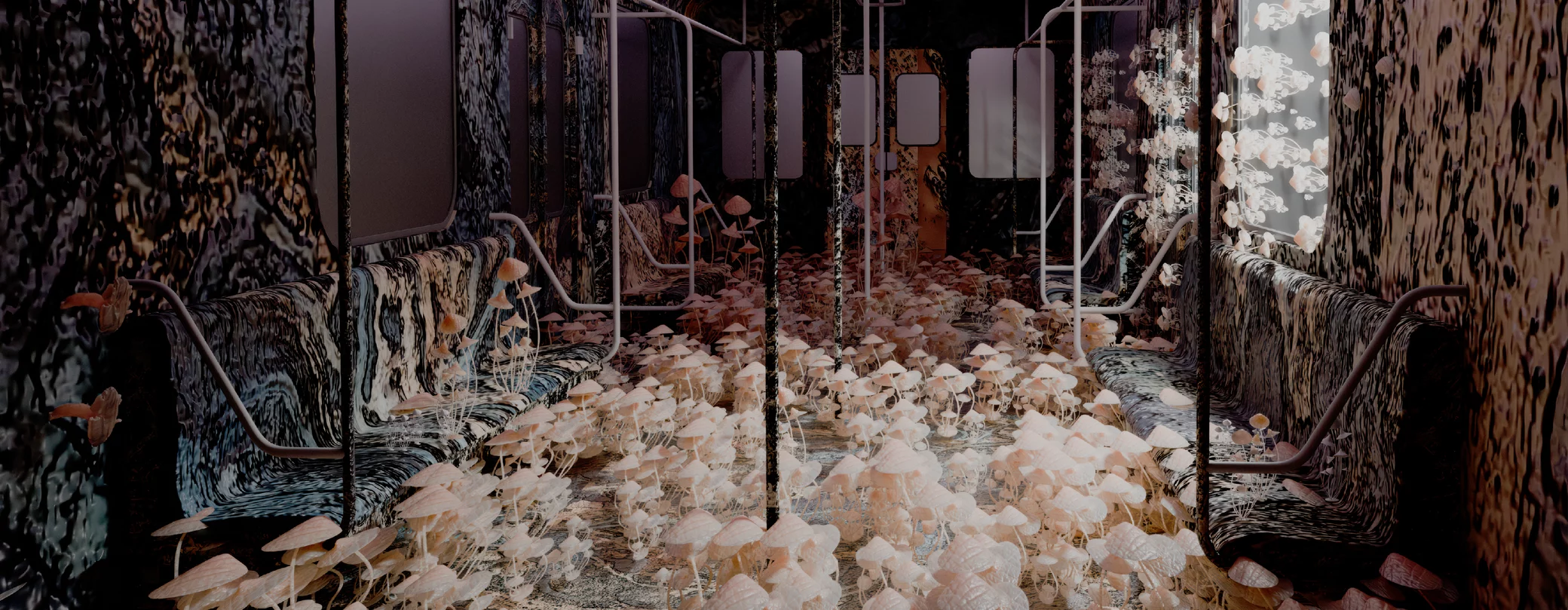
INSIDE A VEHICLE, MOBILITY INFRASTRUCTURES COEXIST WITH EXTRACTIVIST CONDITIONS, WHERE FUNCTION, DECAY, AND MATERIAL DURABILITY CONVERGE.

● W.K.

How does gold mining function within the broader war economy?

● A.I.

Gold is extracted by local communities under pressure or bigger companies with deals linked to government actors and then handed to larger entities, mostly to one of the war parties: the Sudanese Army or the Rapid Support Forces (RSF). Because Sudan and both factions are sanctioned, the gold is smuggled out of the country. The Sudanese Army channels gold through Egypt and sells it there, while the RSF smuggles it to Togo and the United Arab Emirates (UAE). We found that some of this gold ended up in global companies. For example, in 2024, Volkswagen’s annual report mentioned gold from Sudan. When confronted, they said they got it indirectly through third-party suppliers from the UAE—a country that has been accused of providing direct military support to the RSF.

● W.K.

You speak of the gold mines as injuries and as a metaphor for the violence, inflicted on both environment and communities. But your images also convey a sense of resistance. What kind of resistance are you imagining?

● A.I.

In the artworks shown in this report, I used the satellite images of gold mines themselves as the primary visual material. I transformed these images into textures and applied them onto 3D forms, allowing the wounded surface of extraction to become the skin of new sculptural bodies. But I wanted to move beyond showing extractivism solely as violence and, instead, introduce resistance as an active force. In my work, this is symbolized by the mushroom, specifically its rhizome structure. The rhizome grows underground as a decentralized network, spreading horizontally. If one part is cut, the rest continues to live and grow.

I combined the 3D forms with these mushroom structures so that the same visual evidence of violence becomes part of a new form that represents resistance emerging from within destruction—something I learned from the structure of the Sudanese democratic movement itself: neighborhood resistance committees operate like a rhizome.

● W.K.

What could resistance to the extractivist model of gold mining look like? And what role could legal actors play?

● A.I.

We are in the stage of making these structures visible, and we are trying to organize within communities across different spaces, building concrete knowledge about how these operations work.

Legal actors should confront the entities benefiting commercially from this gold. Gold from Sudan moves through international markets and ends up where companies use it. Gold going out means money, and money brings weapons back in. So, it is necessary to expand sanctions, track the people creating and maintaining these routes, and hold them accountable—both in neighboring countries and at the international level.

Artist

Ahmed Isamaldin

Founder ECCHR

Wolfgang Kaleck

LOA is part of ECCHR. We are a human rights organization that relies solely on independent funding and donations from its community. 

Together we use the law to fight for a just world. Free from exploitation, fortressed borders and torture. Support our work with a donation!

LOA is part of ECCHR. We are a human rights organization that relies solely on independent funding and donations from its community. Support our work with a donation!

Donate now!

Thank you for supporting our work for a world free from exploitation, fortressed borders, and torture. Receive regular information and updates in our ECCHR newsletter—subscribe now!