
letters
After twelve years in exile, human rights lawyer and ECCHR Legal Advisor Joumana Seif was able to return to Syria for the first time. She will be reporting from Syria at regular intervals. Subscribe to our "Letter from Damascus".
00:00:00
00:00:00
After twelve years in exile, human rights lawyer and ECCHR Legal Advisor Joumana Seif was able to return to Syria for the first time. She will be reporting from Syria at regular intervals. Subscribe to our "Letter from Damascus".
I write to you again from Damascus after an absence of more than five months. Today, however, I return with important developments on the path toward transitional justice.
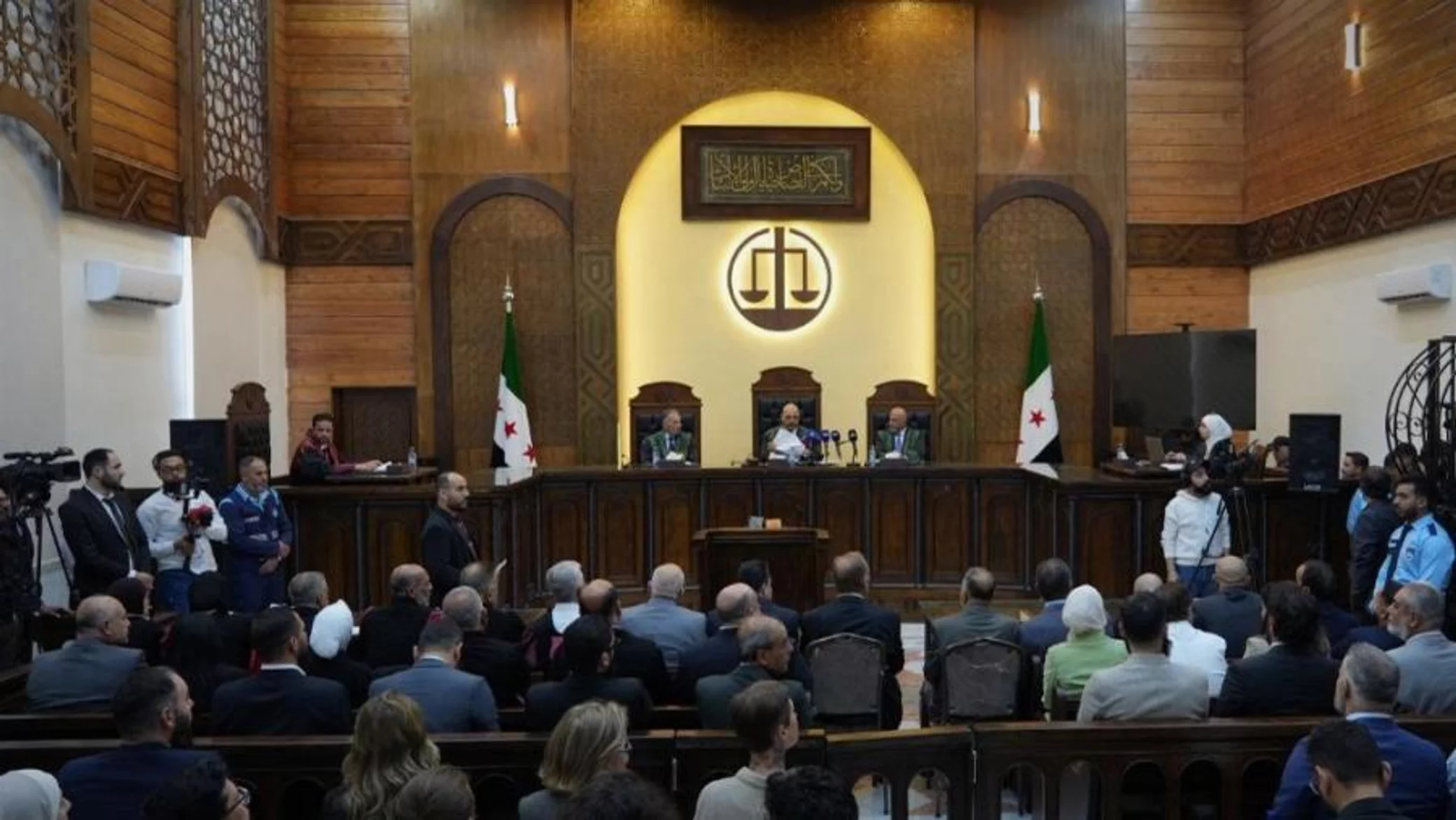
Last month, in April, the first trial within the framework of transitional justice was launched in Damascus. The proceedings began with the trial of eight defendants over the events and massacres in Daraa that took place at the outset of the Syrian uprising in 2011. Among the accused are Bashar al-Assad and Maher al-Assad. While some of the defendants managed to flee the country following the fall of the regime (most likely to Russia, including Bashar and Maher al-Assad), security forces were able, several months ago, to arrest one of them inside Syrian territory – Atef Najib, who is the only one being tried in person.
Atef Najib is known among Syrians as the “Butcher of Daraa.” He is a cousin of Bashar al-Assad and is now facing charges of responsibility for the arrest of the children of Daraa. These were the children who wrote anti-regime slogans on their school walls, and who were later arrested and tortured, while their families were humiliated in March 2011. These events ignited the spark of the Syrian uprising across the country. He is also accused of responsibility for further acts of torture and massacres against civilians.

The phrase "Down with Bashar" was sprayed on the walls of Daraa in the outbreak of the Syrian Revolution 2011. © Jan Sefti
With the support of the head of the National Commission for Transitional Justice, my name was placed on the attendance list for the second hearing of the trial, which was held on 10 May. The number of Syrian and international lawyers, activists, and journalists wishing to attend the trial is enormous, while the courtroom seats, in my estimation, can accommodate no more than seventy people.
My determination to attend the hearing led me to arrive early at the Palace of Justice in central Damascus. I entered the chamber of the Fourth Criminal Court – designated for transitional justice trials – an hour before the session began. Ironically, this is the same courtroom where my father, Riad Seif, was sentenced to five years in prison in 2001 on charges of “undermining the constitution,” after he called for political pluralism and an end to the Ba’ath Party’s monopoly on power. It is also the same courtroom where my father and his colleagues from the Damascus Declaration were sentenced in 2008 to two and a half years in prison for “forming a secret organization.” At that time, it was known as the Second Criminal Court.
That hour of waiting stirred painful memories: I saw my father behind bars again, the prosecution demanding the harshest penalties. I relived the moment the verdict was read: five years in prison and the stripping of his civil rights. Then came the second trial – images of my father and his colleagues crowded into an iron cage in prison uniforms, and Dr. Fidaa Hourani standing beside it, separated as a woman who could not be confined among the men.
These memories faded only when the defendant entered the room. I cannot describe what I felt when the judge began reading the names of the accused, starting with Bashar Hafez al-Assad and Maher Hafez al-Assad.
Yes, this is a step toward justice for millions of Syrians.
In contrast to the first session – which was marked by chaos and described by many as a “show trial,” due to the chants against the Assad regime by victims’ families and the presence of a large number of social media influencers – the second session was characterized by a clear degree of discipline and composure. This shift reflected the court’s effort to regulate the proceedings within the framework set by the Syrian Code of Criminal Procedure, thereby strengthening the guarantees of a fair trial.
At the beginning, the presiding judge read out the indictment. It included legal categorizations such as crimes against humanity, war crimes, and grave violations of the Geneva Conventions. These classifications are significant, as they effectively preclude defenses based on statutes of limitations or the application of prior amnesty laws. This marks an unprecedented development before Syrian courts.
Syrian criminal law does not currently contain provisions defining international crimes or their corresponding penalties. Meanwhile, the draft transitional justice law – which would criminalize such acts – is still pending approval by the People’s Assembly. The Assembly itself is still awaiting the list of members to be appointed by the transitional President, Mr. Ahmad Al Sharaa, so it can be fully constituted and convene to pass legislation.
Perhaps the most contentious issue among Syrian legal and human rights circles is the fact that these trials have begun in the absence of a clearly enacted legal framework. Here, the judiciary's task becomes more difficult. On the one hand, the popular pressure and the victims’ pain and need to see perpetrators held accountable are understandable and should be respected. On the other hand, these initial trials will lay the groundwork for a long process of accountability that must be built on strong legal foundations that do not compromise any victims’ rights and protections. The most pressing and complex question remains: once the new transitional justice law is adopted, will it be applied retroactively to trials that began before its enactment? Or will the proceedings continue under existing Syrian law, which provides for the death penalty in cases of premeditated murder if proven?
In addition to these broader questions, the proceedings were not without well-founded criticism from lawyers and legal experts, particularly regarding the legal classification in the indictment. One of the main objections is that charges of war crimes cannot be applied to events in early 2011, since the situation in Syria was not classified as a non-international armed conflict until July of that year. Some also criticized the omission of serious crimes such as enforced disappearance and persecution as crimes against humanity.
In contrast to these critiques, others argue that the indictment merely reflects the view of the referring judge and does not bind the court in any way. What ultimately matters, they contend, is the course of the trial itself and the final judgment, which will reflect the court’s own assessment and legal reasoning.
Whether one sides with the critics or the defenders, it must be said that the presiding judge demonstrated firm control over the session and a thorough command of the case file, as reflected in his professionalism and in the nature of the questions directed to the defendant during the interrogation. This questioning was set to continue at the next hearing on 19 May.
Another striking irony in this trial is that the presiding judge, Fakhr al-Din al-Aryan, is himself a defector from the Assad regime. The regime had previously issued death sentences against him in absentia and confiscated his assets. It is also worth noting that the Ministry of Justice extended invitations to several civil society organizations to send representatives to attend the trial sessions. This is a noteworthy and commendable precedent, as it signals recognition of the role of civil society in monitoring judicial proceedings.

Joumana Seif during one of the many sessions with the Transitional Justice Commission © Transitional Justice Commission
Before concluding my letter, I would like to inform you that I have completed my work as a member of the National Commission for Transitional Justice at the end of March. I had submitted my resignation in February, with a commitment to continue working through the end of March to ensure a professional handover of my responsibilities. I do not exaggerate in saying that throughout the seven months I spent with the Commission, I carried out my duties with the utmost seriousness and dedication.
I can summarize the reasons for my resignation as stemming from the absence of a clear national strategy for transitional justice in the foreseeable future. In addition, my understanding of independence, inclusivity, and non-discrimination among victims as fundamental principles that must guide the transitional justice process differs from the direction in which matters are currently proceeding. I still hope that my assessment may prove to be mistaken.
In any case, more than a month after my resignation, I do not regret my decision. It has allowed me to dedicate myself fully to managing the Riad Seif Human Rights Foundation, which plays a supportive and complementary role to the work of the Commission. I firmly believe that the pursuit of transitional justice is not solely the responsibility of official bodies; rather, a significant part of this responsibility lies with civil society. Civil society must work to empower and support victims and affected communities as key actors across all pillars of transitional justice: truth-seeking, accountability, reparations, memorialization, and institutional reform – ultimately striving toward sustainable peace.
What has brought me particular comfort after my resignation is that my colleagues and I have maintained strong relationships grounded in mutual respect and goodwill, along with a shared commitment to continued support and cooperation.
With warm wishes,
Joumana Seif
Would you like to read regular updates from Damascus? Subscribe to our "Letter from Damascus".

Joumana Seif has been working in the human rights field since 2001 and supported the democratic movements in Syria with a focus on political prisoners. She left Syria in 2012, a year after the start of the uprising against the Assad regime. Since then, she cofounded the Syrian Women’s Network (2013), the Syrian Feminist Lobby (2014) and Syrian Women’s Political Movement (2017). In 2023, Joumana Seif received the Anne Klein Women's Award from the Heinrich Böll Foundation for her work as a human rights advocate.
She joined ECCHR’s International Crimes and Accountability program in May 2017 as research fellow, and from March 2022 as legal advisor with a particular focus on Syria and sexual and gender-based violence. Inter alia, she worked on the al-Khatib trial before the Higher Regional Court of Koblenz by closely supporting the survivors.
A few weeks after the fall of the Assad regime in Syria, she travelled back to her home country for the first time with her father Riad Seif, one of the best-known Syrian opposition activists, who was imprisoned in the Assad regime's prisons for many years.
LOA is part of ECCHR. We are a human rights organization that relies solely on independent funding and donations from its community. Support our work with a donation!
Thank you for supporting our work for a world free from exploitation, fortressed borders, and torture. Receive regular information and updates in our ECCHR newsletter—subscribe now!