After twelve years in exile, human rights lawyer and ECCHR Legal Advisor Joumana Seif was able to return to Syria for the first time. She will be reporting from Syria at regular intervals. Subscribe to our "Letter from Damascus".
00:00:00
00:00:00

After twelve years in exile, human rights lawyer and ECCHR Legal Advisor Joumana Seif was able to return to Syria for the first time. She will be reporting from Syria at regular intervals. Subscribe to our "Letter from Damascus".
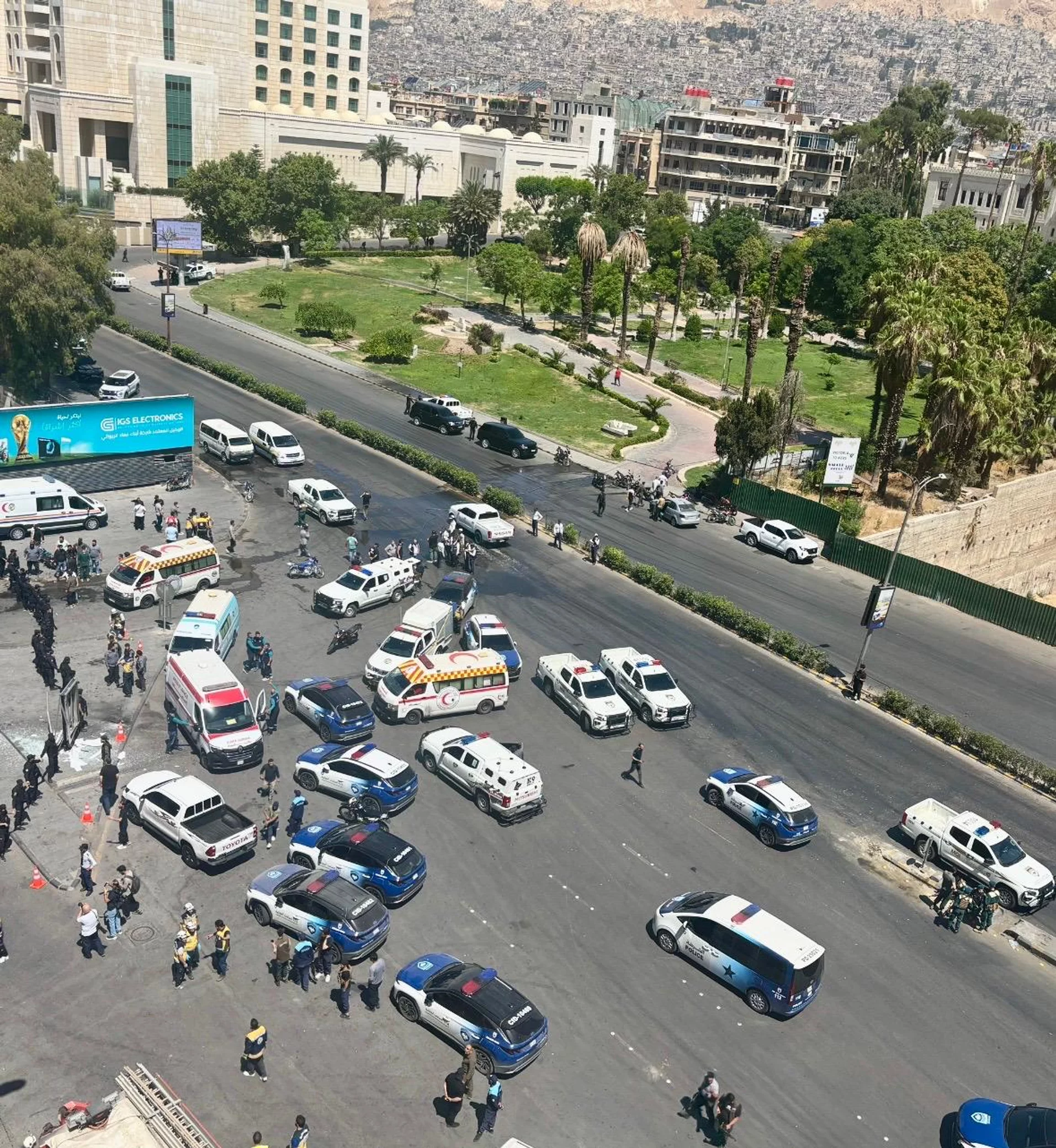
The attack that took place on 2 July at a café near the Palace of Justice in Damascus claimed the lives of nine people and injured 28 others, most of whom were lawyers. A few days later, on 7 July, two successive explosions, occurred during the state visit of French President Emmanuel Macron to Damascus. The blast took place less than 30 meters from our office, only minutes after my colleague and I had passed through the same location. The explosion left us and our neighbours deeply shaken and fearful. I am not exaggerating when I say that my senses remain on constant alert. My heart still races whenever I pass through that same place every day.
Incidents as these highlight a broader reality: since the fall of the Assad regime, the new Syrian authorities have achieved notable and rapid progress in the field of foreign policy. However, these achievements have yet been to translate into tangible improvements in the lives of ordinary citizens domestically. On the contrary, people continue to face growing challenges in their daily lives, particularly in relation to living conditions, the economy, and security.

Only 21 out of 210 - women in Aleppo are protesting about their underrepresentation in the People's Assembly. © Joumana Seif
Two weeks ago, after a delay of more than nine months, the People's Assembly held its inaugural session on July 12, 2026. As Syria’s new parliament, it is expected to draft a new constitution, pass legislation, approve the state budget, and exercise oversight over the government – at least in theory. In practice, however, the experience of the past year and a half suggest that these powers remain largely nominal. During its first session, the Assembly elected a Speaker, two Deputy Speakers (including one woman), and a Secretary after resolving disagreements between some of its members and the executive authority over the procedures for electing its leadership.
The Assembly convened after President Ahmed al-Sharaa announced the 70 members he had directly appointed to complete its composition. Under the Constitutional Declaration, the President exercises broad authority over the People's Assembly’s formation through a two-stage process: first, the selection of the members of the High Committee responsible for overseeing the selection of two-thirds of the Assembly’s members through a limited quasi-electoral process; and second, the direct appointment of the remaining one-third.
The Constitutional Declaration also adopted a presidential system of governance, eliminating the position of Prime Minister and assigning all executive powers and functions to the President of the Republic. As for the judiciary, the structure of the Supreme Judicial Council remained unchanged from the Assad-era system. Under this framework, the President of the Republic continues to chair the Supreme Judicial Council, with the Minister of Justice serving as deputy chair, while all other members are appointed by the executive authority. The President was also granted the power to appoint all members of the Supreme Constitutional Court, whose role was limited to providing advisory opinions upon the request of the President.
In summary, Syria currently has a single centralized authority represented by the executive branch under the President Ahmed al-Sharaa, with other institutions – including the People's Assembly, the judiciary, and the Constitutional Court – deriving their authority from it. At the same time, the legislative and judicial branches lack effective powers to oversee, hold accountable, or check the executive authority.
Against this backdrop, each new political development has further polarized the divisions among Syrian society, especially as restrictions on political activity and the formation of political parties continue. Some view these measures as necessary to navigate the country’s transitional period and linked political and economic challenges. Others believe that Syria is drifting in the wrong direction, toward a new form of authoritarianism, undermining the very aspirations and sacrifices made in pursuit of freedom, justice, and dignity.

In the beginning of July, women organized a protest in Aleppo to express their opposition to women being excluded from appointments to the People's Assembly. © Joumana Seif
()[null]

Frauen demonstrieren Anfang Juli in Aleppo gegen ihre politische Marginalisierung. © Joumana Seif
The formation of the "People's Assembly" has sparked extensive public debate, generating dozens of hours of televised discussions and thousands of social media posts, and they continue to do so. Supporters argue that the Assembly will operate independently, exercise its full mandate, and effectively fulfil its responsibilities. Critics, however, strongly object, believing that the Assembly will merely function as a scapegoat for future failures while lacking the authority to bring about meaningful reform.
The main objections to the process of selecting the Assembly members can be summarized in three key points:
1. Lack of transparency
The selection process lacked clear and transparent criteria, raising concerns about whether the Assembly includes the expertise needed to draft Syria’s future constitutional and legal framework. This expertise should cover areas such as constitutional law, legislation and legal drafting, education and scientific research, strategic planning, trade unions, civil society, and other technical fields.
2. Insufficient representation of women
Women make up only 21 of the 210 Assembly members (around 10%), despite earlier assurances that gender representation would be improved. The outcome was widely criticised by women’s rights advocates, who viewed it as a sign of continued political marginalisation. On 2 July, the Aleppo Women Activists’ Gathering organized a peaceful protest in Aleppo University Square to express their strong opposition to the exclusion of women in the appointments to the People's Assembly.
3. Conflicts of interest
Seven members of the High Elections Committee were included in the President’s list of appointees to the People's Assembly, raising concerns regarding compliance with standards of independence and impartiality.
Syria remains in the midst of a defining moment in its history. I firmly believe that building a state founded on the rule of law and strong institutions is a shared responsibility; one that every Syrian can contribute to their circumstances and abilities. My hope for my beloved country, Syria, is a future defined by greater justice, stability, and prosperity. Despite the immense challenges that lie ahead of us, we remain sustained by hope.
With warm wishes,
Joumana Seif
P.S. If you like the Letter from Damascus, please feel free to forward it. If you have received it as a forward, you can easily subscribe via this link.

Joumana Seif has been working in the human rights field since 2001 and supported the democratic movements in Syria with a focus on political prisoners. She left Syria in 2012, a year after the start of the uprising against the Assad regime. Since then, she cofounded the Syrian Women’s Network (2013), the Syrian Feminist Lobby (2014) and Syrian Women’s Political Movement (2017). In 2023, Joumana Seif received the Anne Klein Women's Award from the Heinrich Böll Foundation for her work as a human rights advocate.
She joined ECCHR’s International Crimes and Accountability program in May 2017 as research fellow, and from March 2022 as legal advisor with a particular focus on Syria and sexual and gender-based violence. Inter alia, she worked on the al-Khatib trial before the Higher Regional Court of Koblenz by closely supporting the survivors.
A few weeks after the fall of the Assad regime in Syria, she travelled back to her home country for the first time with her father Riad Seif, one of the best-known Syrian opposition activists, who was imprisoned in the Assad regime's prisons for many years.
LOA is part of ECCHR. We are a human rights organization that relies solely on independent funding and donations from its community. Support our work with a donation!
Thank you for supporting our work for a world free from exploitation, fortressed borders, and torture. Receive regular information and updates in our ECCHR newsletter—subscribe now!